Litigation Document Services: How Legal Teams Keep Case Materials Organized and Proceeding-Ready
Litigation can generate a substantial volume of documents, often arriving in different formats, sizes, and stages of organization. Preparing those materials for discovery, depositions, hearings, or trial can quickly become another time-consuming responsibility for an already busy legal team.
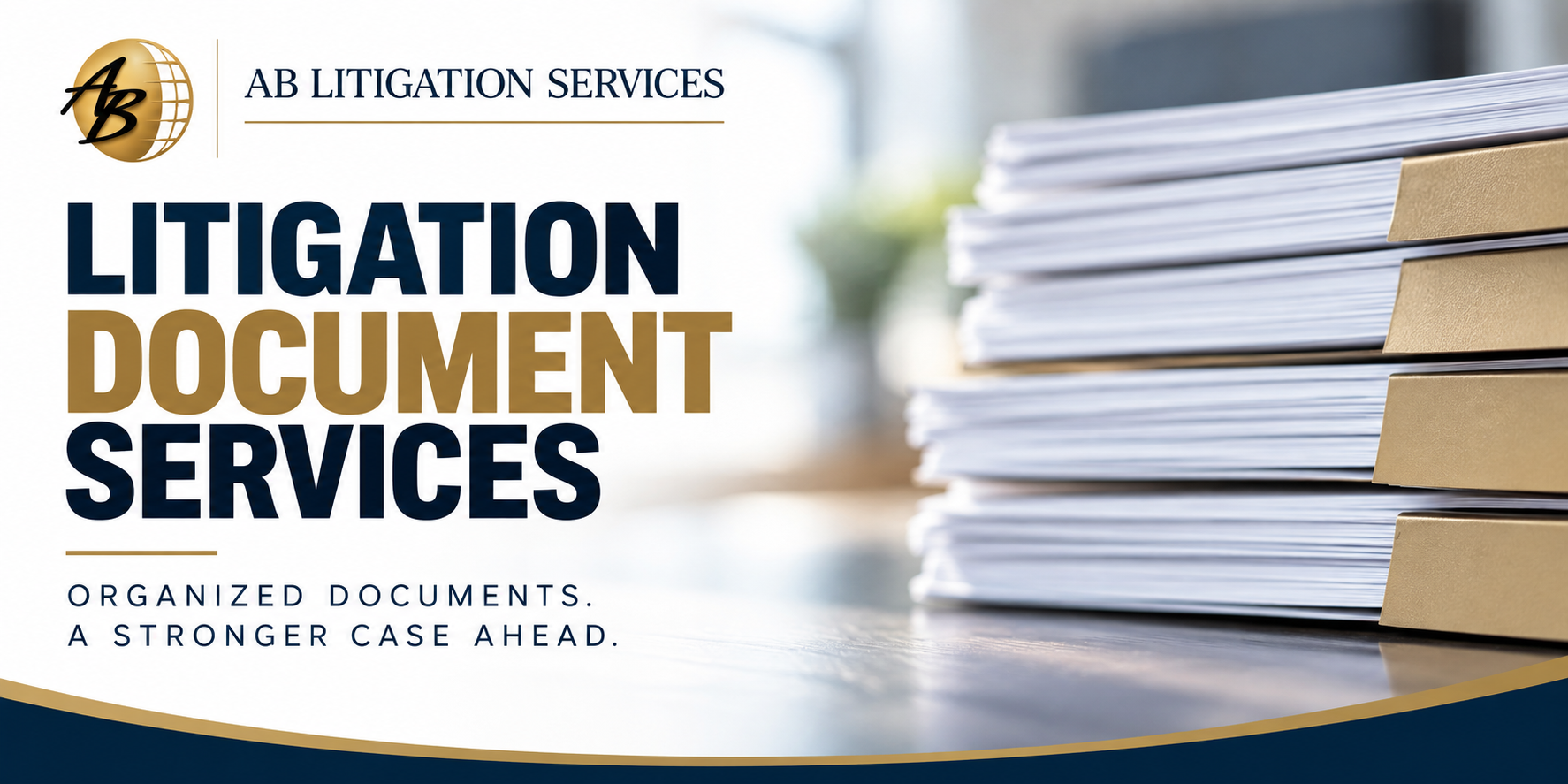
Professional litigation document services help turn those materials into organized, accessible, and consistently prepared files. AB Litigation Services provides scanning, imaging, OCR, Bates numbering, printing, copying, and related document production services to help legal professionals prepare case materials efficiently and accurately.
Why Document Preparation Becomes Complicated in Litigation
A case rarely arrives as one perfectly organized collection of searchable digital files.
Legal teams may be working with paper records, PDFs, photographs, oversized exhibits, scanned images, and electronic files from multiple sources. Those materials may need to be converted, numbered, reproduced, organized, or prepared in specific formats before they can be used effectively.
For paralegals and litigation teams, the challenge is not simply handling documents. It is maintaining an organized workflow while managing deadlines and coordinating the many other details surrounding a matter.
Outsourcing litigation document production can reduce that administrative burden while providing a consistent process for preparing case materials.
What Do Litigation Document Services Include?
Litigation document services encompass the processes used to reproduce, organize, convert, and prepare case materials for legal proceedings.
Depending on the needs of the matter, AB Litigation Services can assist with:
- High-volume document scanning and imaging
- Optical character recognition, or OCR
- Bates numbering and electronic document branding
- Copying and printing
- Image conversion and enhancement
- Load-file generation
- Oversized document reproduction
- Reduction and enlargement
- Binding, tabs, dividers, and document finishing
- Online document hosting and disclosure management
- Preparation of files for litigation support applications
Bringing these capabilities together can simplify production, particularly when a matter involves both physical and electronic documents.
Bates Numbering Helps Create a Consistent Document Record
Large document sets become difficult to manage when individual pages cannot be identified quickly and consistently.
Bates numbering assigns a unique sequential identifier to documents or pages. This creates a standardized reference system that legal teams can use when organizing, reviewing, exchanging, or referring to materials.
AB Litigation Services provides electronic Bates numbering and labeling as part of its litigation document services. Electronic branding can also be used to apply appropriate identifiers to digital document sets.
For legal teams managing large productions, a consistent numbering system makes it easier to locate and reference the correct material throughout the life of the matter.
OCR Turns Scanned Documents Into Searchable Files
Scanning a paper document creates a digital image, but an image alone may not make the text searchable.
Optical character recognition, commonly known as OCR, identifies text within scanned documents and converts it into machine-readable information. This can make large digital document collections considerably easier to search and review.
For example, instead of manually reviewing hundreds of scanned pages to locate a name or term, OCR may allow the legal team to search the converted files electronically.
OCR can be particularly useful when converting substantial collections of paper records into a more practical digital format.
Scanning and Imaging Bring Physical Records Into the Digital Workflow
Paper remains a reality in litigation.
Medical records, business documents, correspondence, photographs, historical files, and other materials may arrive in physical form. High-volume scanning allows those records to become part of an organized digital workflow.
AB Litigation Services provides scanning and imaging services for litigation materials, including image conversion and enhancement when appropriate.
The objective is straightforward: create clear, usable digital materials while maintaining an organized production process.
For large document sets, professional scanning also removes a significant production task from the legal team’s internal workload.
Printing and Physical Document Production Still Matter
Digital files have transformed litigation workflows, but physical documents have not disappeared.
Attorneys may still require printed materials for depositions, hearings, trial preparation, exhibits, witness preparation, internal review, or other proceeding needs.
AB Litigation Services provides copying and printing along with finishing options such as binding, tabs, and dividers. Reduction and enlargement are also available when materials need to be reproduced at a different size.
Having digital and physical document capabilities available through the same litigation services provider can make it easier to move between formats as a matter develops.
Oversized Materials Require Specialized Production
Not every important case document fits neatly onto a standard sheet of paper.
Maps, diagrams, architectural drawings, technical materials, charts, and other oversized documents may need specialized scanning or reproduction. These materials may also require enlargement, reduction, mounting, or other preparation before use.
AB Litigation Services provides oversized document reproduction and related production capabilities, giving legal teams another option for managing materials that cannot be handled effectively with standard office equipment.
Quality Control Is an Essential Part of Document Production
Speed matters when deadlines are approaching, but document production also requires careful attention to detail.
A missing page, illegible scan, incorrect sequence, or inconsistent file can create unnecessary additional work for the legal team. Quality control should therefore be part of the production process rather than an afterthought.
AB Litigation Services utilizes a quality control process for document services. This added review helps ensure materials are prepared consistently before delivery.
For legal professionals, that means less time spent troubleshooting production issues and more confidence that the materials received are ready for the next stage of the matter.
One Partner Can Simplify Litigation Document Production
Document production often overlaps with other litigation logistics.
A deposition, for example, may require document scanning and preparation alongside a certified court reporter, legal videographer, interpreter, videoconferencing technology, or conference facilities. A case approaching trial may require document production in addition to trial presentation support.
Coordinating those needs separately can create more emails, more vendor relationships, and more opportunities for details to become disconnected.
AB Litigation Services provides comprehensive litigation support under one experienced relationship. Legal teams can coordinate document services alongside court reporting, legal videography, trial presentation, transcription, interpreting and translation, conference facilities, and other proceeding needs.
It is part of our Nationwide Reach, Local Touch approach: dependable litigation support with responsive coordination through a team you know.
Frequently Asked Questions About Litigation Document Services
What is litigation document production?
Litigation document production is the process of preparing case-related documents for review, exchange, depositions, hearings, trial, or other legal proceedings. Services may include scanning, imaging, OCR, Bates numbering, printing, copying, file conversion, and document finishing.
What is the difference between scanning and OCR?
Scanning creates a digital image of a physical document. OCR analyzes the text within that image and converts it into machine-readable information, which can make the resulting files searchable.
Can Bates numbers be added to electronic documents?
Yes. Electronic Bates numbering can apply sequential identifiers to digital document sets, helping legal teams organize and reference individual pages or documents consistently.
Can oversized documents be reproduced?
Yes. AB Litigation Services can assist with oversized reproduction as well as enlargement, reduction, and related production needs for materials that do not fit standard document sizes.
Can document services be coordinated with other litigation support?
Yes. AB Litigation Services provides document services alongside court reporting, legal videography, trial presentation, transcription, interpreting and translation, conference facilities, and videoconferencing. Coordinating related services through one provider can reduce the administrative work involved in preparing for a proceeding.
Keep Your Litigation Documents Organized and Proceeding-Ready
The more documents a matter generates, the more important a reliable production process becomes.
AB Litigation Services helps legal teams convert, organize, reproduce, and prepare case materials with professional document services backed by more than 60 years of experience supporting the legal community.
Whether you need high-volume scanning, OCR, Bates numbering, printing, imaging, oversized reproduction, or a combination of services, our team can help coordinate the details.
Contact AB Litigation Services to discuss your litigation document service needs and keep your case materials organized, accessible, and ready for the next proceeding.