
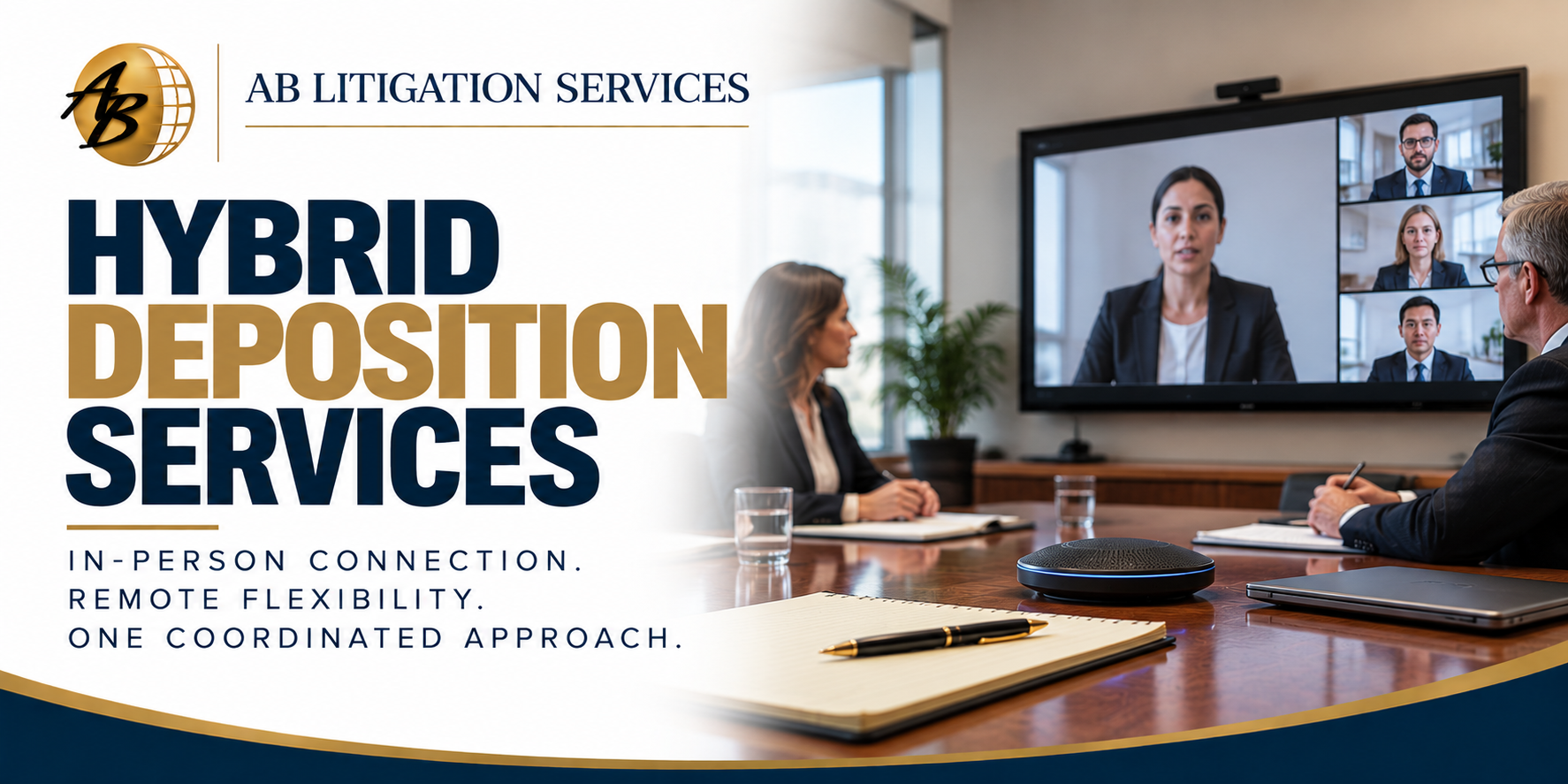
Hybrid Deposition Services: How to Coordinate In-Person and Remote Participants
Hybrid depositions allow some participants to attend a deposition in person while others join remotely through videoconferencing technology. This flexible format can reduce travel requirements and accommodate attorneys, witnesses, and other participants in different locations. AB Litigation Services provides hybrid deposition services, including certified court reporting, videoconferencing, legal videography, and coordinated technical support, helping legal teams manage both in-person and remote participation through one experienced litigation support provider.
While hybrid depositions offer convenience, they also require careful coordination. Audio, video, participant communication, exhibits, and reporting services must work together so everyone can participate effectively.
For attorneys and paralegals managing multiple proceedings, professional hybrid deposition support can simplify these logistics and reduce the administrative burden of coordinating several different providers.
What Is a Hybrid Deposition?
A hybrid deposition combines traditional in-person attendance with remote participation.
For example, a witness and court reporter may be physically present in a conference room while attorneys join remotely. In another arrangement, the examining attorney and witness may attend in person while opposing counsel, a legal videographer, or an interpreter participates from another location.
The specific arrangement depends on the needs of the proceeding and applicable legal requirements.
Unlike a fully remote deposition, where everyone participates virtually, a hybrid deposition requires coordination between a physical meeting location and a digital conferencing environment.
This creates additional considerations for technology, communication, and participant access.
Why Hybrid Depositions Require More Coordination
A traditional in-person deposition generally brings participants together in one location. A fully remote deposition connects participants through an online platform.
A hybrid deposition must accommodate both environments simultaneously.
The legal team may need to coordinate:
- A suitable physical deposition location
- Videoconferencing access for remote participants
- Microphones and audio equipment that capture everyone clearly
- Cameras and displays for communication between locations
- Certified court reporting
- Legal videography when requested
- Interpreting services when needed
- Electronic and physical exhibits
- Technical assistance before and during the proceeding
Each element has a specific purpose, but all must function together.
For a busy litigation team, managing these details internally can create unnecessary work. Professional hybrid deposition services provide a more centralized approach to preparation and coordination.
Reliable Audio and Video Are Essential
Clear communication is one of the most important requirements of a successful hybrid deposition.
In a physical conference room, participants can generally hear one another directly. Remote participants, however, depend on microphones, speakers, cameras, and the videoconferencing connection.
A poorly positioned microphone may make it difficult for remote attendees to hear a witness. Similarly, a remote participant may have difficulty following the proceeding if the camera does not adequately capture the room.
These challenges make equipment selection and setup important.
Professional hybrid deposition support can help coordinate appropriate audio and video equipment, test connections, and establish a workable conferencing environment before testimony begins.
AB Litigation Services provides videoconferencing and deposition technology support to help legal teams prepare for proceedings involving participants in multiple locations.
Coordinating Court Reporting for a Hybrid Deposition
Certified court reporting remains a central component of hybrid depositions.
Whether the court reporter attends in person or remotely, the reporter must be able to hear and accurately capture testimony throughout the proceeding.
That makes clear audio, appropriate participant communication, and an organized deposition environment especially important.
When multiple participants speak from different locations, the reporting process can become more complicated if audio quality is inconsistent or speakers interrupt one another.
AB Litigation Services provides certified court reporting as part of its comprehensive deposition support.
Our team can coordinate reporting services alongside the videoconferencing arrangements needed for a hybrid proceeding, helping reduce the number of separate providers the legal team must manage.
For proceedings requiring immediate transcript access, AB Litigation Services also has a team of Certified Realtime Reporters available to support realtime reporting needs, subject to scheduling and availability.
Legal Videography Adds Another Layer of Preparation
Some hybrid depositions require professional video recording in addition to certified court reporting.
Legal videography captures testimony visually and audibly, creating a recording that may be used for review or subsequent presentation, subject to applicable requirements.
In a hybrid setting, the recording arrangement deserves particular attention.
The legal team must determine what needs to be recorded, where participants will be located, and how the recording will be captured.
A professional legal videographer can help manage the technical recording process while the court reporter focuses on the written record.
AB Litigation Services provides both court reporting and legal videography, allowing legal teams to coordinate these complementary services through one litigation support relationship.
This approach can be especially helpful when video recordings will later require editing, transcript synchronization, or trial presentation preparation.
Managing Exhibits With Remote and In-Person Participants
Exhibit presentation is another important consideration in hybrid depositions.
When everyone attends in person, printed documents may be distributed around the conference table. In a hybrid proceeding, remote participants must also be able to access and review the appropriate materials.
Depending on the proceeding, exhibits may be shared electronically, displayed through the videoconferencing platform, or provided in physical form.
The legal team should establish an exhibit-sharing process that accounts for both groups of participants.
This may include determining how documents will be displayed, how participants will identify exhibits, and how electronic materials will be made available during questioning.
AB Litigation Services also provides document services, including scanning, imaging, Bates numbering, OCR, and document production.
These capabilities can help legal teams prepare materials that need to be converted, organized, or reproduced before a deposition.
Hybrid Depositions Can Reduce Travel Without Eliminating Professional Support
One of the primary advantages of hybrid depositions is flexibility.
An attorney may be able to participate remotely rather than travel to another city. A witness may appear at a designated physical location while other members of the legal team join virtually.
This can be particularly useful when a matter involves participants in different states or when travel would create unnecessary scheduling complications.
However, reducing travel does not eliminate the need for professional deposition services.
Court reporting, legal videography, interpreting, exhibit preparation, and technical coordination may still be necessary.
AB Litigation Services helps legal teams coordinate these services through its nationwide litigation support network.
Our Nationwide Reach, Local Touch approach allows clients to maintain an established point of contact while arranging deposition support in different locations.
Why One Point of Contact Makes Hybrid Depositions Easier to Manage
Hybrid depositions can involve several service providers and multiple locations.
Without centralized coordination, the paralegal or legal operations professional responsible for scheduling may need to communicate separately with a court reporter, videographer, conference facility, technology provider, and interpreter.
Each additional provider creates another set of details to confirm and manage.
AB Litigation Services offers a more integrated approach.
Our comprehensive litigation support services allow legal teams to coordinate court reporting, legal videography, videoconferencing, interpreting and translation, conference facilities, and document services through one established relationship.
That does not eliminate every logistical consideration, but it can simplify communication and reduce the administrative work required to prepare for the proceeding.
For litigation professionals managing several depositions at once, that consistency can be particularly valuable.
Preparing for a Hybrid Deposition Before the Proceeding
Much of the work involved in a hybrid deposition takes place before testimony begins.
The preparation process should account for the physical location, remote participants, technology requirements, reporting arrangements, and any additional services.
Important considerations include:
- Participant locations: Identify who will attend in person and who will join remotely.
- Technology requirements: Determine the appropriate conferencing platform, audio equipment, cameras, and displays.
- Court reporting: Coordinate the reporter’s participation and ensure the reporting arrangement supports the proceeding.
- Legal videography: Confirm recording needs and how video will be captured.
- Exhibit access: Establish a process for presenting documents to both in-person and remote participants.
- Technical testing: Allow time to check connections, audio, video, and other equipment before the deposition begins.
- Additional services: Coordinate interpreting, conference facilities, and other support when necessary.
These preparations help establish a more organized workflow and provide an opportunity to address technical concerns before the proceeding.
Professional hybrid deposition services can assist with coordinating many of these operational details.
Frequently Asked Questions About Hybrid Deposition Services
What Is the Difference Between a Hybrid Deposition and a Remote Deposition?
A hybrid deposition includes both in-person and remote participants. A fully remote deposition generally involves all participants joining through videoconferencing. Hybrid proceedings require coordination between the physical location and the remote conferencing environment.
How Are Exhibits Shared During a Hybrid Deposition?
Exhibits may be shared through electronic document systems, videoconferencing screen sharing, or physical copies. The appropriate approach depends on the deposition format, participant needs, and applicable procedures.
Does AB Litigation Services Provide Hybrid Deposition Support Outside Colorado?
Yes. AB Litigation Services provides nationwide deposition coordination through its professional network. Legal teams can arrange court reporting, videoconferencing, legal videography, and related litigation support through one established point of contact.
Schedule Your Next Hybrid Deposition With AB Litigation Services
Hybrid depositions provide valuable flexibility, but bringing in-person and remote participants together requires more than a videoconferencing link.
Court reporting, audio and video technology, legal videography, exhibits, and participant coordination all contribute to an organized proceeding.
AB Litigation Services combines more than 60 years of experience supporting the legal community with comprehensive deposition services and nationwide coordination.
Whether your next deposition involves one remote attorney or several participants across multiple locations, our team can help coordinate the reporting, technology, and litigation support needed for the proceeding.
Contact AB Litigation Services to schedule your next hybrid deposition and discuss the court reporting, videoconferencing, and technical support your legal team needs.


